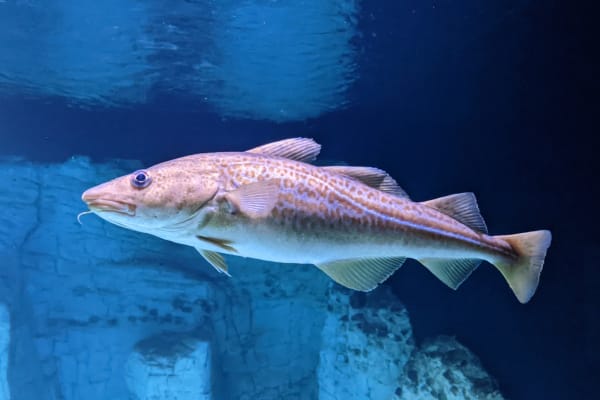
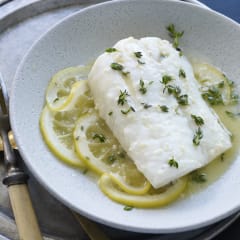
Cabillaud and Sablefish are different fish, but they're close enough in the kitchen to stand in for one another.
Gadidae
Cabillaud
Fresh Atlantic cod (*Gadus morhua*) as it's sold in French and northern-European fishmongers — firm, white-fleshed, mild, and flaking into large pearly leaves when cooked. The same species that becomes salted Morue (Bacalhau in Portuguese) when cured for months, but treated as a different culinary entity in fresh form: cabillaud rôti with hollandaise, cabillaud poché à l'huile d'olive, dos de cabillaud en croûte d'herbes, and the bistro classic cabillaud sauce vierge are built around its mild profile and clean separation. Once cured into Morue, the fish reaches a different shelf in the same shop; the recipes change too — brandade, accras, bacalhau à brás. The naming convention reflects this: in modern French, cabillaud always means fresh, morue almost always means cured.
Full guide →
Anoplopomatidae
Sablefish
Sablefish is sold nearly everywhere as black cod, and it is not a cod — Anoplopoma fimbria is the sole commercial member of its own family, a deep-water North Pacific fish caught on longlines from Oregon to the Bering Sea. The name matters less than the fat. It carries the highest oil content of any Alaskan whitefish, around 15 percent, which is why the flesh is pearly white, breaks into unusually large silky flakes, and is close to impossible to overcook: the fat keeps it moist long after a halibut of the same thickness has dried out. That richness is what made it the classic fish for miso marinade in Japan, where it is gindara, and the reason a black cod fillet costs several times what a true cod does. Two naming confusions are worth carrying to the counter. In Spanish it is bacalao negro, but so — loosely and often — is Patagonian toothfish (Dissostichus eleginoides), the fish sold in English as Chilean sea bass and in Argentina and Chile as merluza negra; they are unrelated, from opposite hemispheres, though both are fatty white deep-water fish and cook similarly. And in English, sablefish is regularly muddled with the black scabbardfish of Madeira and mainland Portugal, another dark deep-water species with a comparable reputation and a completely different body.
Full guide →Named as a cod and priced like nothing of the sort. Sablefish carries roughly fifteen percent oil against cod's one, so they behave differently under heat: cod dries the moment it passes done, sablefish stays silky. Substituting cod into a black cod recipe means cutting the cooking time and watching it.
| Country | Cabillaud | Sablefish |
|---|
| 🇺🇸United States | Cod | Sablefish |
| 🇬🇧United Kingdom | Cod | Black cod |
| 🇫🇷France | Cabillaud | Morue charbonnière |
| 🇪🇸Spain | Bacalao fresco | Bacalao negro |
| 🇦🇷Argentina | Bacalao fresco | — |
| 🇲🇽Mexico | Bacalao fresco | Bacalao negro |
| 🇵🇹Portugal | Bacalhau fresco | — |
| 🇧🇷Brazil | Bacalhau fresco | — |
| 🇮🇹Italy | Merluzzo | — |
| 🇩🇪Germany | Kabeljau | Kohlenfisch |
$129.00–$325.00 · Free US shipping (except Hawaii) · Alaska Gold Seafood
Wild Pacific cod, when the Atlantic stock is the problem
- ·Longline-caught Gadus macrocephalus
- ·Boneless 6 oz portions
- ·Individually vacuum-sealed and frozen
- ·5, 10 or 20 lb box
Wild Alaska Pacific Cod
Affiliate link — CarneAtlas may earn a commission at no extra cost to you. Price checked 31 Aug 2026.
Browse every species in the atlas on the fish index, or identify one from a photo with Identify my cut.