Adjacent cuts from the hindquarter with similar flavor profiles — rump has slightly more chew and flavor while sirloin is marginally more tender.
These are related cuts, but not perfect swaps. Use the table below to judge how close your local option is before buying.

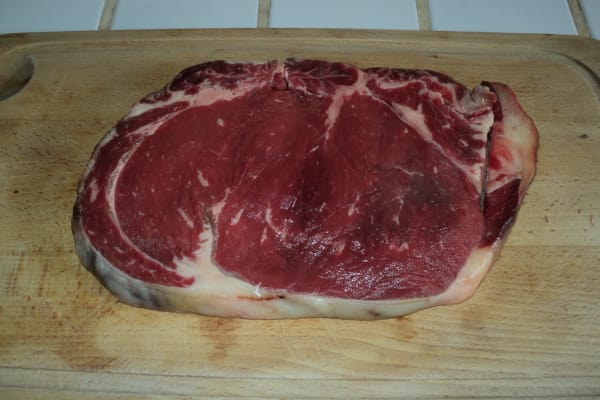
Which sirloin? The British and American words name different steaks
In Britain a sirloin steak is cut from the loin along the middle of the back. That is the muscle an American butcher sells as a New York strip. The American "sirloin" sits further back, between the loin and the hip, and covers much the same ground a British butcher calls rump.
So the question means two different things. Asked in the UK, "rump or sirloin" compares two separate muscles. Asked in the US, a sirloin steak and a British rump steak are close relatives from the same part of the animal.
Which is more tender, rump or sirloin?
British sirloin is the more tender of the two. The loin does little work, so its grain is fine and even, and it carries a strip of fat along one edge that bastes it as it cooks.
Rump comes from the hip, which works harder. It is firmer, has more chew and a deeper, beefier flavour, and it is usually cheaper. A thick rump steak is also several muscles rather than one, each with its own grain, which is why it can feel uneven from one end to the other.
Which should you buy?
- For tenderness
- Sirloin in the British sense (New York strip in the US).
- For flavour and price
- Rump, or American top sirloin. It rewards a good sear and careful slicing more than a higher grade.
- To feed a crowd
- Rump. A whole piece roasts or grills well and slices thin across the grain.
How to cook each
Both are quick-cooking steaks for a very hot pan or grill. Sirloin: stand it on its fat edge first to render the fat, then sear both faces, and take it off at medium-rare. Rump: sear hard, stop at medium-rare to medium, rest it for five minutes, then slice it across the grain. Past medium, the extra work in the muscle shows up as toughness.
Asking for them abroad
- France
- Rump is rumsteck; British sirloin is faux-filet or contre-filet.
- Spain
- Rump is cadera; British sirloin is lomo bajo.
- Argentina
- Rump is bife de cuadril; British sirloin is bife angosto.
- Italy
- Rump is scamone; British sirloin is controfiletto.
- Germany
- Rump steak is Hüftsteak, cut from the Hüfte.
Names by country
| Country | Rump steak | Sirloin |
|---|---|---|
| 🇺🇸United States | Rump steak | Sirloin |
| 🇬🇧United Kingdom | Rump steak | — |
| 🇫🇷France | Rumsteck | — |
| 🇪🇸Spain | Cadera | — |
| 🇦🇷Argentina | Bife de cuadril | Cuadril |
| 🇲🇽Mexico | — | Aguayón |
| 🇮🇹Italy | Scamone | — |
| 🇩🇪Germany | Hüftsteak | Hüfte |