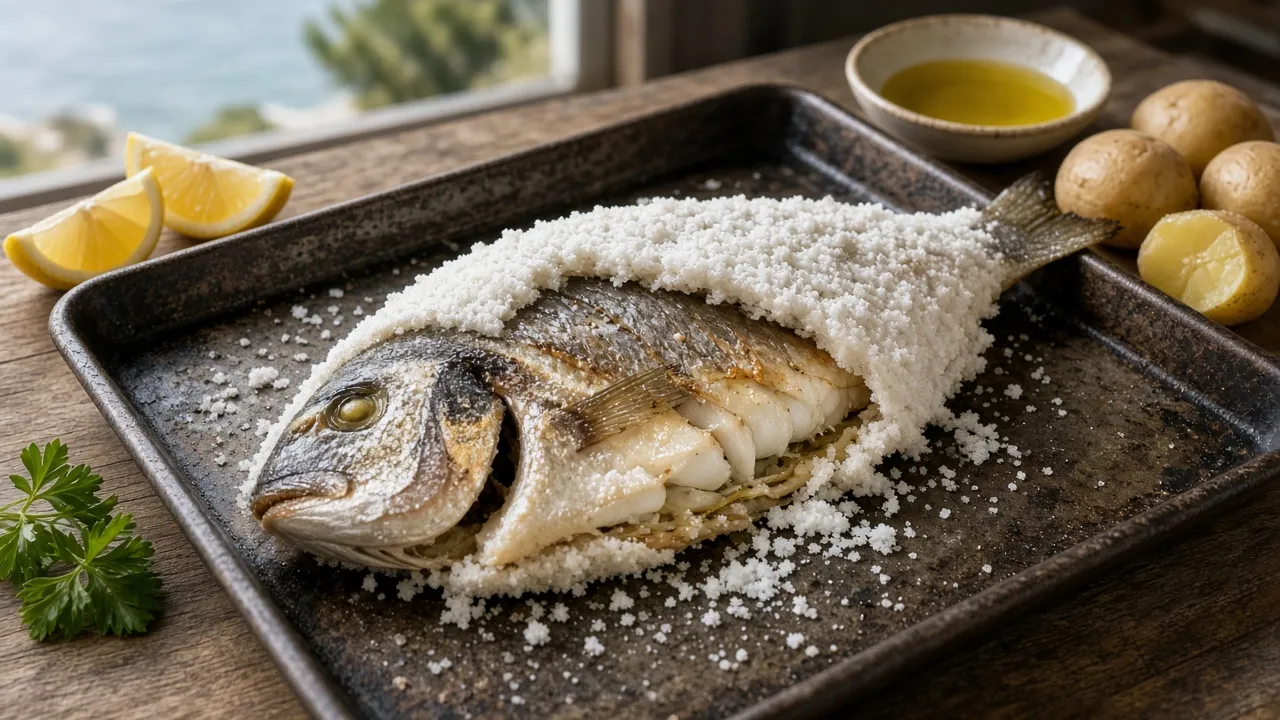
Whole gilthead sea bream baked under a crust of coarse salt, the way it is served along Spain's Mediterranean coast. The crust seals the fish so it steams in its own juices; crack it open at the table and the skin peels away with it, leaving moist flesh that is not salty at all.
Serves 2Prep 15 minCook 25 min
Can't find Dorada?
Loup de mer — Both are farmed Mediterranean fish with mild white flesh, similar size, and best cooked whole — sea bass is slightly more delicate, bream slightly sweeter.
Mojarra — Both are mild, white, versatile farmed fish — tilapia is softer and more neutral in flavor, sea bream has more character and is better suited to whole cooking.
Pompano — Both are small, prized whole-cooking fish with rich, sweet white flesh — pompano has a richer, butterier flavor, sea bream is more delicate and Mediterranean in character.
Saint-Pierre — Both are whole-cooking white fish suited to roasting on the bone — sea bream is milder and much cheaper, Saint-Pierre firmer with a cleaner, sweeter flavour.
Besugo — Both are Sparidae roasted whole on the bone, and besugo is the deeper-water, slower-growing, considerably more expensive relative — finer and sweeter, where dorada is milder and everyday.
Ingredients & method
Ingredients
1 whole dorada (gilthead sea bream), 600 to 800 g, gutted but NOT scaled
2 kg coarse sea salt
2 egg whites (or 100 ml water)
½ lemon, sliced
A few sprigs of flat-leaf parsley, and a bay leaf
To serve: good extra-virgin olive oil, lemon wedges, boiled or roasted potatoes, a green salad
Method
1Heat the oven to 220 °C (425 °F). Leave the scales on: with the skin, they keep the salt out of the flesh.
2Rinse the fish, pat it dry, and fill the cavity with the lemon slices, parsley and bay leaf.
3Mix the salt with the egg whites until it feels like damp sand and holds together when squeezed.
4Spread a third of the salt in an ovenproof dish or tray, slightly longer than the fish, about 1 cm thick. Lay the fish on top.
5Pack the rest of the salt over the fish, pressing it into an even crust about 1 cm thick with no gaps. You can leave the tail sticking out.
6Bake for 20 to 25 minutes for a 600 to 800 g fish. A thermometer pushed through the crust into the thickest part, by the backbone, should read about 55 °C (130 °F); the heat trapped in the crust carries it higher as it rests.
7Rest 5 minutes, then crack the crust with the back of a heavy spoon and lift it away in pieces. Brush off the loose salt.
8Peel back the skin, lift the top fillet off the bone, pull out the spine, and serve both fillets with olive oil and lemon.
Cook this well
$$ · filleting, skinning, and trimming whole fish
Fillet a whole fish without wasting half of it
Following the bones and contours of whole fish with a narrow, flexible blade.
Affiliate links — CarneAtlas may earn a commission at no extra cost to you.See all recommended gear
Chef's tip A whole fish is the whole point: fillets in a salt crust turn salty. The same method works for lubina (sea bass) and any whole white fish of a similar size. Allow about 5 minutes more for every extra 200 g.
Cook this later?Save the recipe, then keep notes on what worked and what you'd change next time.